
Office Address
308/H-2, Netaji Subhash Place, Pitampura, New Delhi, Delhi, 110034
Phone Number
+91 9650715139
Email Address
hello@shrinext.com
308/H-2, Netaji Subhash Place, Pitampura, New Delhi, Delhi, 110034
+91 9650715139
hello@shrinext.com






 by Shrinext HealthTech
Healthcare is becoming increasingly digital, connected, data-driven, and patient-centric.
Hospitals, clinics, healthcare startups, diagnostic centers, pharmacies, insurers, NGOs, public health organizations, and digital health companies are investing in software platforms that can connect people, workflows, healthcare data, and external systems.
Traditional healthcare software, however, often creates isolated systems.
One application may manage appointments. Another may manage patient records. A third may handle billing. A separate platform may provide telemedicine, while analytics are handled somewhere else.
This creates a fragmented technology environment.
Healthcare SaaS development offers a different approach.
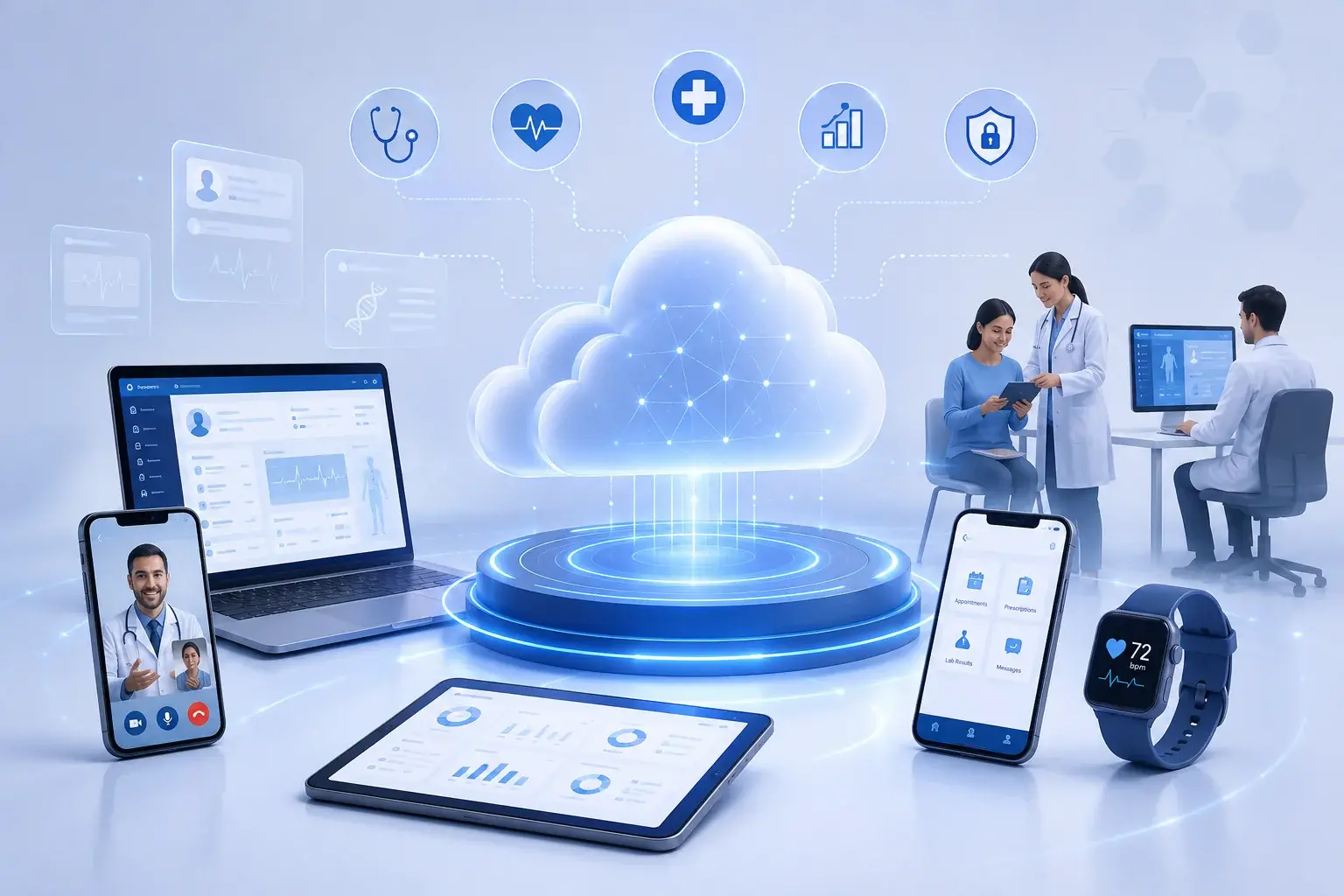
A well-designed healthcare SaaS platform can bring multiple workflows together through a centralized, scalable, cloud-enabled software architecture.
Depending on the business model and requirements, a healthcare SaaS platform can support:
But building healthcare SaaS is not simply a matter of putting an application on the cloud.
Healthcare software must consider security, privacy, interoperability, scalability, usability, data governance, regulatory requirements, integrations, and long-term maintainability.
This guide explains how healthcare SaaS development works, what features and architecture are important, what it can cost, and how organizations can plan a successful healthcare SaaS platform in 2026.
Healthcare SaaS, or Healthcare Software as a Service, is a software delivery model in which healthcare applications are hosted and operated through cloud infrastructure and made available to authorized users through web or mobile interfaces.
Instead of installing and maintaining separate software environments for every customer or location, a SaaS platform can provide centralized application infrastructure with appropriate organizational and data separation.
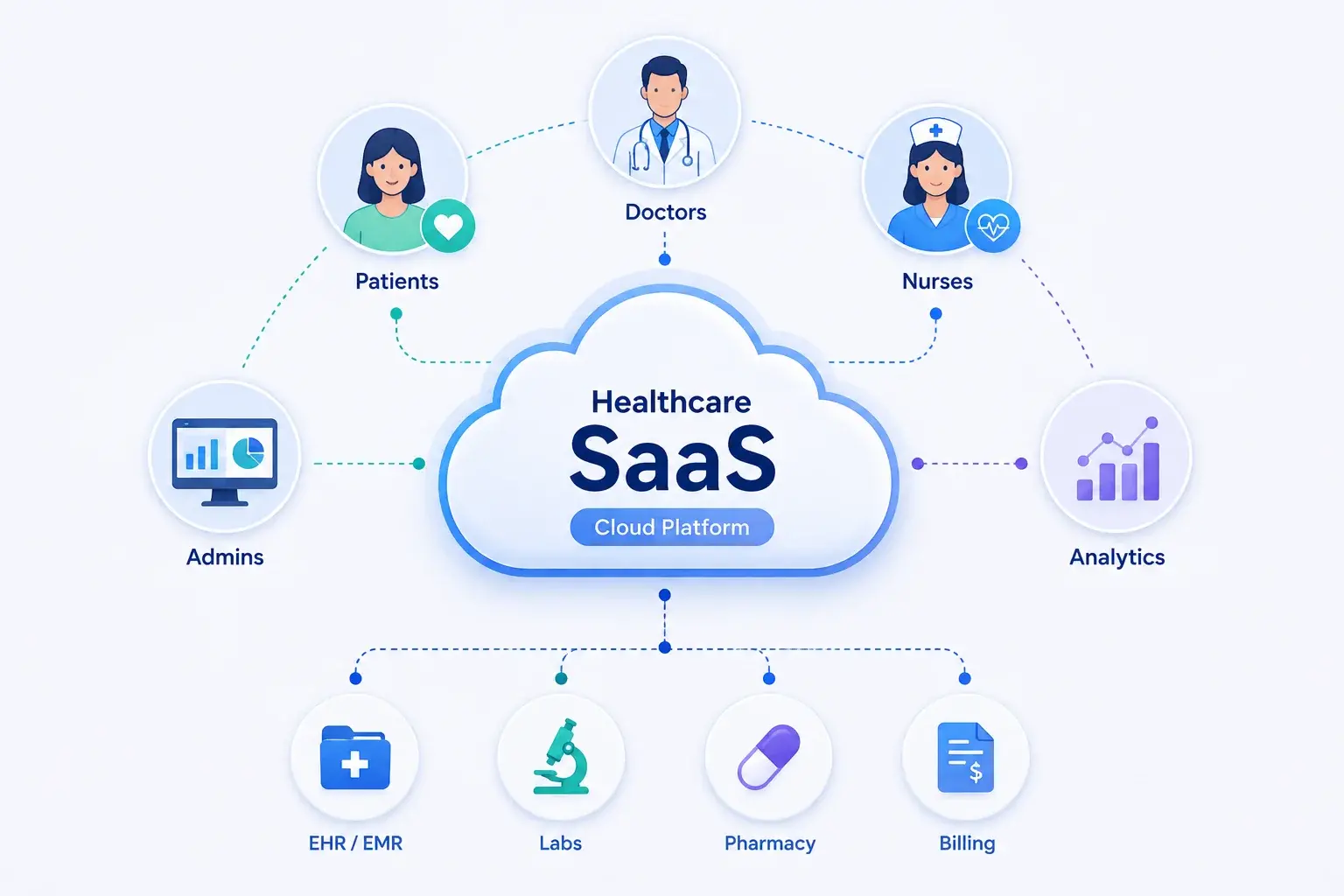
For example, a healthcare SaaS platform could allow:
Healthcare Organization → Staff → Patients → Workflows → Integrations → Analytics
A multi-organization platform could potentially support:
Organization A
Patients → Doctors → Appointments → Records
Organization B
Patients → Doctors → Appointments → Records
while using a common application architecture with appropriate tenant isolation and access controls.
Healthcare SaaS does not necessarily mean a ready-made healthcare product.
Organizations may choose to build a custom healthcare SaaS platform specifically around their business model and workflows.
This is particularly useful for healthcare startups and organizations whose requirements do not fit generic software.
One of the first decisions organizations need to make is whether they need traditional software, SaaS, or a hybrid model.
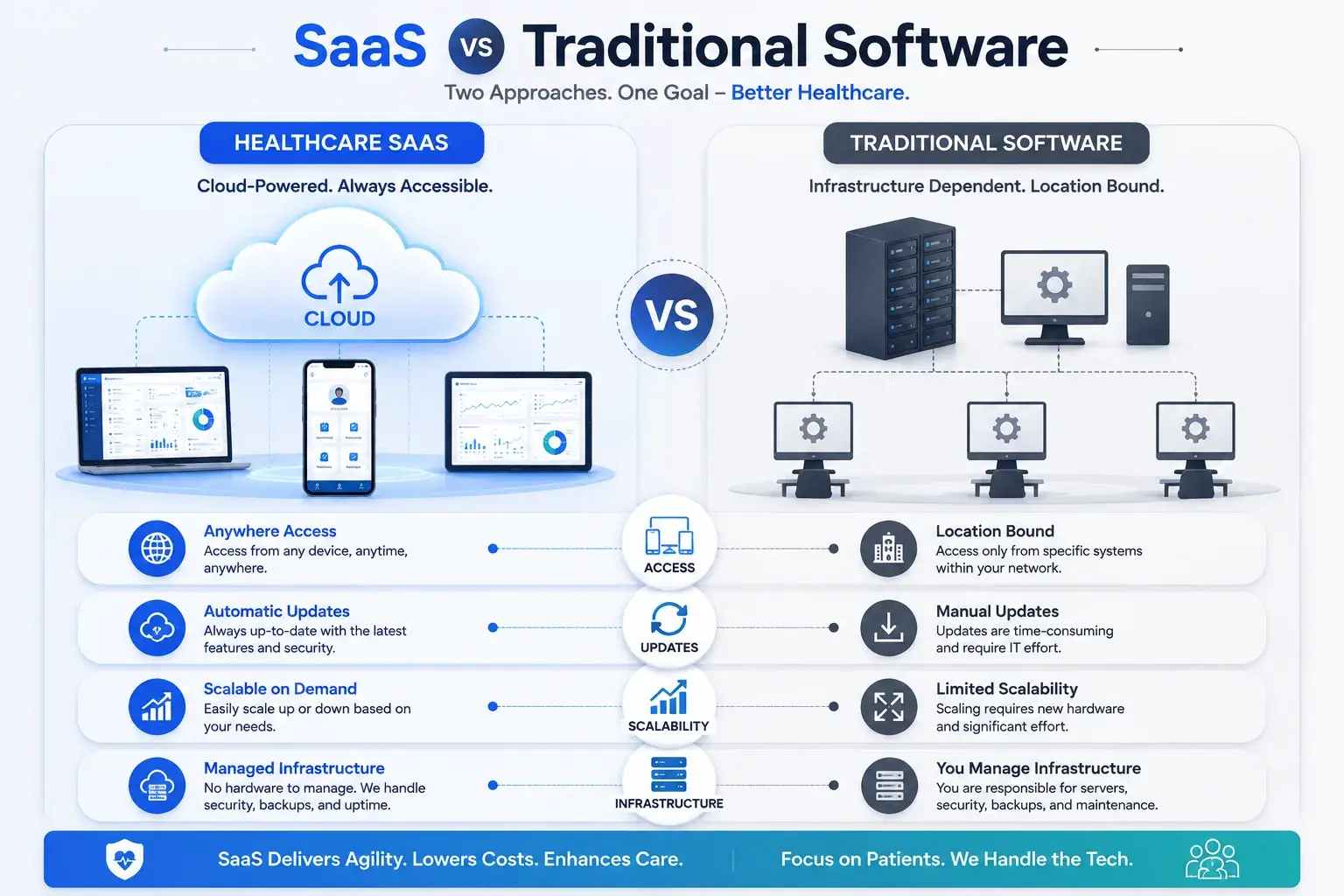
| Traditional Healthcare Software | Healthcare SaaS |
|---|---|
| Often deployed separately | Centralized cloud delivery |
| Higher infrastructure responsibility | Managed cloud infrastructure |
| Updates may be manual | Centralized updates |
| Can be location-specific | Designed for remote access |
| Scaling can require infrastructure changes | Architecture can support scalable growth |
| Integration may be customized per deployment | APIs can be built into the platform |
| Suitable for certain enterprise environments | Suitable for multi-organization platforms |
Neither model is automatically better.
The correct approach depends on the organization's:
Healthcare SaaS is a broad category. Different organizations may need completely different platforms.
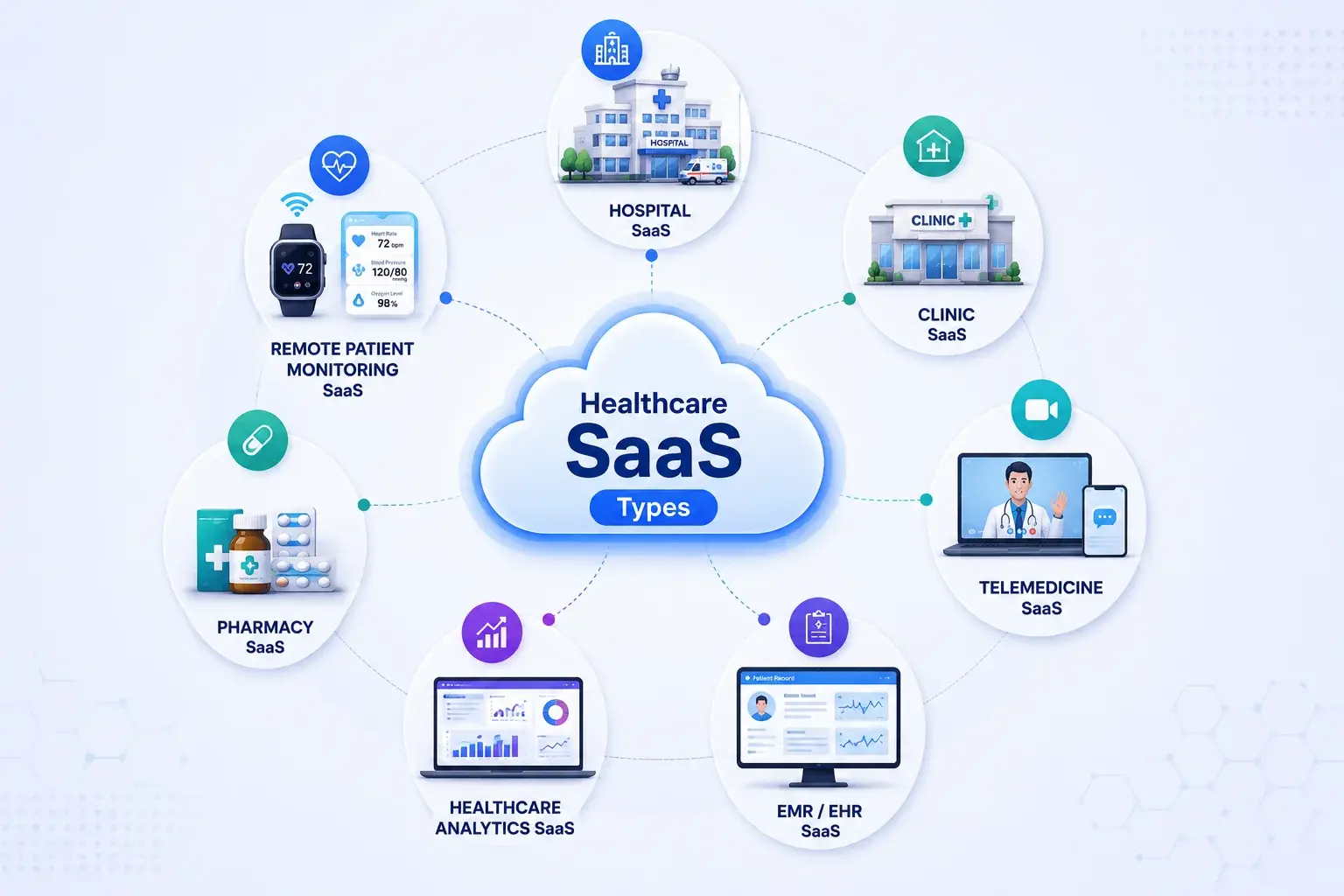
Hospital-focused SaaS applications can support:
Clinics may require simpler workflows such as:
Telemedicine platforms can include:
These platforms focus on digital clinical records and may integrate with other healthcare systems through APIs and interoperability standards.
Analytics platforms can aggregate information from multiple systems and provide:
RPM platforms can connect:
Patient → Device → Data → Cloud → Healthcare Provider → Alert/Action
Potential functionality includes:
Laboratory platforms can support:
A successful platform should not simply contain a large number of features.
The features should support the actual healthcare workflow.
A SaaS platform may have:
Each user should have appropriate access.
Role-based permissions can determine:
This is particularly important for healthcare applications.
Patient management may include:
Features may include:
Dashboards can provide visibility into:
Architecture is one of the most important decisions in healthcare SaaS development.
A typical architecture can contain several layers.
This includes:
This contains:
This layer connects the platform with external systems.
Examples include:
Depending on the project, this may contain:
This can include:
Multi-tenancy is one of the most important concepts in SaaS.
Imagine a platform serving:
Hospital A
Hospital B
Clinic C
Healthcare Startup D
All customers may use the same core platform, but their data, users, configuration, workflows, and permissions must be appropriately separated.
A healthcare SaaS architecture therefore needs to carefully address:
Multi-tenancy should be considered during architecture design rather than added as an afterthought.
Security should be built into the platform from the beginning.
Important considerations include:
Protect sensitive data during transmission and, where appropriate, at rest.
Depending on the platform:
may be appropriate.
Users should only have access to information and functionality required for their role.
The platform can maintain records of:
A healthcare platform should have an appropriate backup and recovery strategy based on business requirements.
No.
This is an important point for healthcare organizations targeting the U.S. market.
Simply using cloud infrastructure or calling an application "healthcare SaaS" does not make it HIPAA compliant.
The overall implementation may involve:
Therefore, a development company should avoid casually claiming that a software product is "HIPAA certified."
A better approach is to design the platform to support applicable privacy and security requirements and have the organization's compliance and legal teams assess the complete environment.
One of the biggest opportunities—and challenges—in healthcare SaaS is interoperability.
Healthcare organizations rarely operate in isolation.
A new SaaS platform may need to communicate with:
FHIR is an important modern healthcare interoperability standard.
CMS continues to promote FHIR-based API adoption, and its interoperability framework includes FHIR APIs and USCDI-related requirements.
The CMS Interoperability and Prior Authorization Final Rule includes API requirements whose major compliance dates generally begin in 2027, including requirements involving Patient Access, Payer-to-Payer and Prior Authorization APIs.
In 2026, CMS is also proposing further interoperability and electronic prior-authorization requirements related to drugs and additional FHIR implementation specifications.
Interoperability should be considered from the beginning.
A strong architecture can include:
Healthcare SaaS → API Gateway → FHIR/HL7 Layer → External Healthcare Systems
rather than developing every integration as an isolated custom connection.
Artificial intelligence is becoming a major component of healthcare software.
However, AI should solve a meaningful healthcare problem rather than simply being added for marketing.
Potential use cases include:
For appropriate administrative, informational, and engagement workflows.
Identify patterns and potential risks from historical healthcare data.
Support healthcare professionals with documentation workflows where appropriate safeguards and human oversight are maintained.
AI can personalize communication and help users navigate digital health workflows.
AI can support:
ONC's HTI-1 Final Rule is particularly relevant to healthcare technology companies because it introduces algorithm-transparency requirements for AI and predictive algorithms incorporated into certified health IT.
This reinforces an important principle:
Healthcare AI needs governance, not just technology.
Healthcare organizations produce enormous amounts of information.
But data alone does not create value.
A healthcare SaaS platform can transform data into actionable dashboards.
Organizations can potentially use historical data to identify trends and risks.
Cloud architecture can support scalability and centralized management.
A cloud-enabled healthcare SaaS platform can include:
However, "cloud" should not simply mean putting an existing application on a virtual machine.
A modern cloud architecture should consider:
Healthcare SaaS increasingly requires mobile experiences.
A platform may have separate applications for:
Patients
Doctors
Field Workers
Mobile applications can become an important extension of the core SaaS platform.
A successful project should follow a structured process.
Before choosing technology, define:
Map the complete workflow.
For example:
Patient Registration
↓
Appointment
↓
Consultation
↓
Clinical Documentation
↓
Prescription
↓
Billing
↓
Follow-Up
↓
Analytics
This helps prevent disconnected feature development.
A common mistake is trying to build everything at once.
Instead, identify the smallest product capable of delivering the core value.
An MVP could contain:
Define:
Development may include:
Testing should cover:
Healthcare SaaS development does not end at launch.
Post-launch activities may include:
A startup may begin with a focused MVP.
For example:
This staged approach can reduce initial development risk while creating a roadmap for growth.
This is one of the most commercially important questions.
There is no universal price.
The development cost depends on:
A simple healthcare SaaS MVP and a large enterprise healthcare platform can have dramatically different development costs.
Instead of asking:
"How much does healthcare SaaS cost?"
start with:
What exactly needs to be built?
A professional estimation process should identify:
Only then can a meaningful development estimate be prepared.
The timeline also varies significantly.
A focused MVP may require substantially less time than a large enterprise platform.
The major factors include:
A practical project can be divided into:
Discovery → UX/UI → Architecture → Development → Integration → Testing → Deployment
This makes progress measurable and helps identify dependencies early.
More features do not necessarily mean more value.
If integrations are required, API and interoperability architecture should be considered early.
Security needs to be part of architecture and development.
Healthcare software can become difficult to use when workflows are designed without sufficient user research.
AI should solve a measurable problem.
A platform designed for 100 users may behave very differently when supporting 100,000 users.
Healthcare SaaS should be designed to evolve.
Healthcare startups often need to move quickly while maintaining a strong technology foundation.
A custom SaaS platform can help a startup create technology around its unique business model rather than adapting its business to generic software.
Potential startup projects include:
The development strategy should focus on validating the business model first and scaling the architecture progressively.
Established healthcare organizations may have completely different priorities.
They may need:
In these cases, custom development can complement rather than replace existing systems.
Choosing the right development partner can have a significant impact on the project.
Look for a partner that understands:
Not just generic software development.
FHIR, APIs, HL7, and integration architecture where relevant.
Healthcare data requires careful security planning.
The platform should be designed for appropriate scalability and availability.
Healthcare SaaS often requires multiple user experiences.
Where these capabilities are part of the business requirement.
The technology partner should be capable of supporting future versions, integrations, and enhancements.
AI is moving from experimentation toward practical workflow integration.
Healthcare organizations increasingly need connected systems.
CMS continues to expand its interoperability strategy around FHIR APIs.
The healthcare ecosystem is moving toward more standardized electronic prior authorization workflows, with major CMS API requirements beginning in 2027 for impacted payers.
Organizations continue to modernize infrastructure and applications.
Data is increasingly being used for operational and population-level insights.
Telemedicine and remote monitoring continue to expand digital care models.
Healthcare organizations will increasingly need to understand how AI systems work, how they are evaluated, and how they are governed. ONC's HTI-1 framework is an important example of this direction.
Every healthcare organization is different.
A hospital network does not operate like a telemedicine startup.
A diagnostic center does not operate like a health insurer.
A community health organization does not have the same workflow as a pharmacy platform.
Therefore, software should be designed around the actual business and healthcare workflow.
Custom development can provide flexibility around:
Shrinext HealthTech provides custom healthcare software development and technology services for organizations looking to build, modernize, integrate, or scale digital health solutions.
Our capabilities include:
We focus on custom development and technology services, rather than presenting a fixed off-the-shelf product as the answer to every healthcare problem.
Our approach can start with understanding the organization's:
Business → Healthcare Workflow → Users → Data → Integrations → Technology → Growth Roadmap
From there, the solution can be designed around the organization's actual requirements.
Whether you are:
the first step is to clearly define the problem, users, workflows, integrations, and technical requirements.
Shrinext HealthTech can help you move from healthcare technology concept to custom software development, integration, deployment, and ongoing enhancement.
Shrinext HealthTech
Simplifying HealthTech with Care